
A reseller tried to sync 18,000 products to his Shopify store.
The sync wasn't the real problem.

From my desk today
I was helping a reseller set up the product sync between Randmar Connect and his Shopify store.
The sync wasn't running smoothly. And we quickly understood why.
He was trying to sync 18,000 SKUs.
That's a lot of data to move, even with today's internet.
But once we put the technical side aside, we ended up having a much more interesting conversation. Not about how to sync 18,000 products. About whether he should be selling 18,000 products at all.
A few weeks ago, I wrote about selling 20,000 products without stocking them. That's still true. But being able to list everything doesn't mean you should.
The retailer reality
Listing a product is the easy part.
Every product you put online also has to be:
- Kept up to date: price, stock, images, specs.
- Found: search, categories, SEO.
- Marketed: ads, emails, social posts.
- Supported: questions, returns, reviews.
Now multiply that by 18,000.
On a small team and a limited marketing budget, that's not a store. It's a warehouse catalogue nobody has time to sell from.
And here's what nobody tells you: most of those products will rarely, if ever, sell.
Behind the scenes at Randmar
I wanted to see what that looks like in real life. So I pulled 90 days of sales for two of our top-performing resellers.
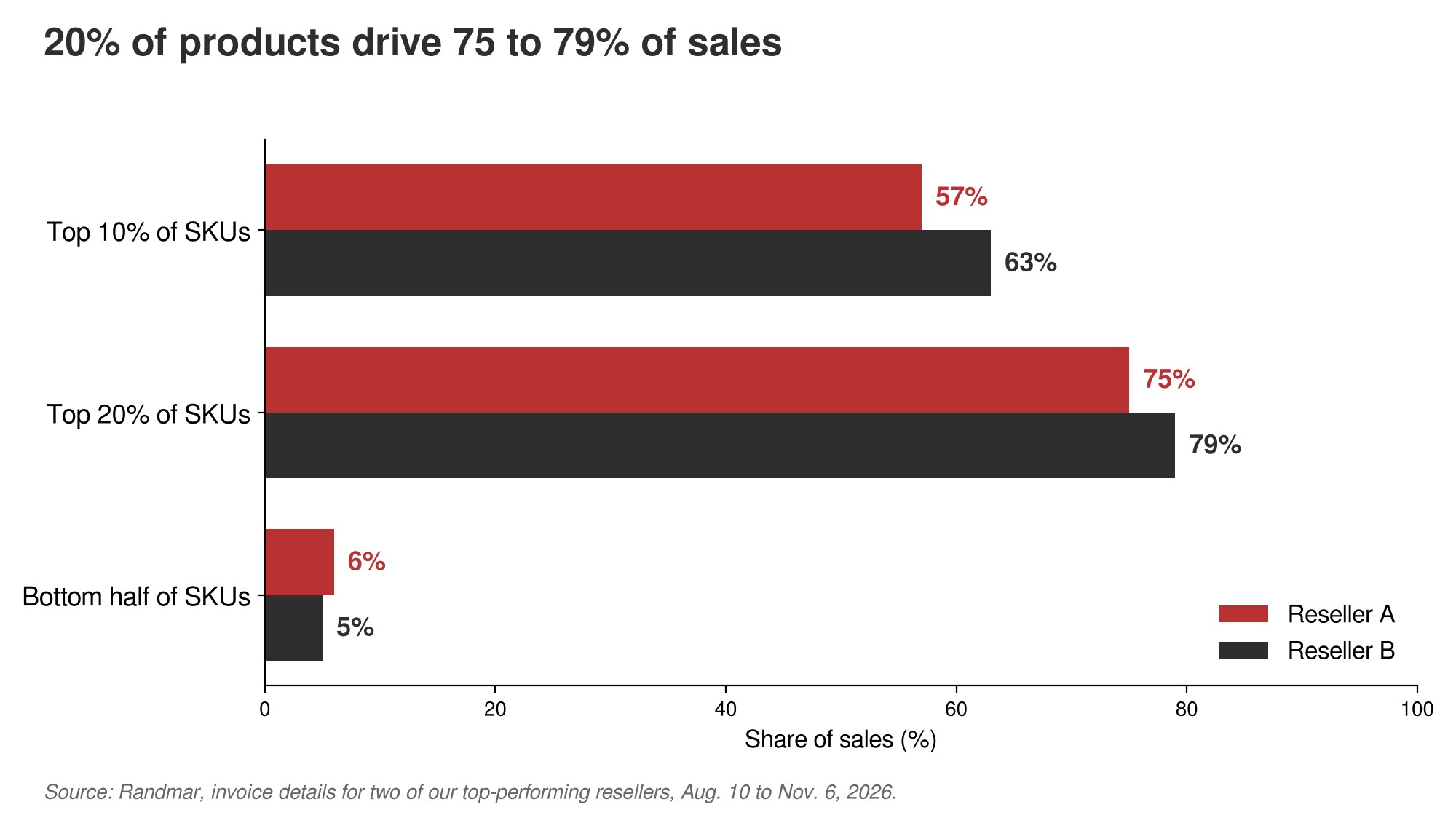
By SKU: a few products make most of the sales.
| Last 90 days | Reseller A | Reseller B |
|---|---|---|
| Sales from the top 10% of SKUs | 57% | 63% |
| Sales from the top 20% of SKUs | 75% | 79% |
| Sales from the bottom half of SKUs | 6% | 5% |
| SKUs ordered only once | 41% | 39% |
By manufacturer: two or three brands carry the business.
| Last 90 days | Reseller A | Reseller B |
|---|---|---|
| Manufacturers ordered from | 28 | 28 |
| Sales from the top 3 manufacturers | 86% | 91% |
| Manufacturers needed to reach 80% of sales | 3 | 2 |
| Manufacturers under 1% of sales each | 19 (2.8% of sales combined) | 23 (1.4% of sales combined) |
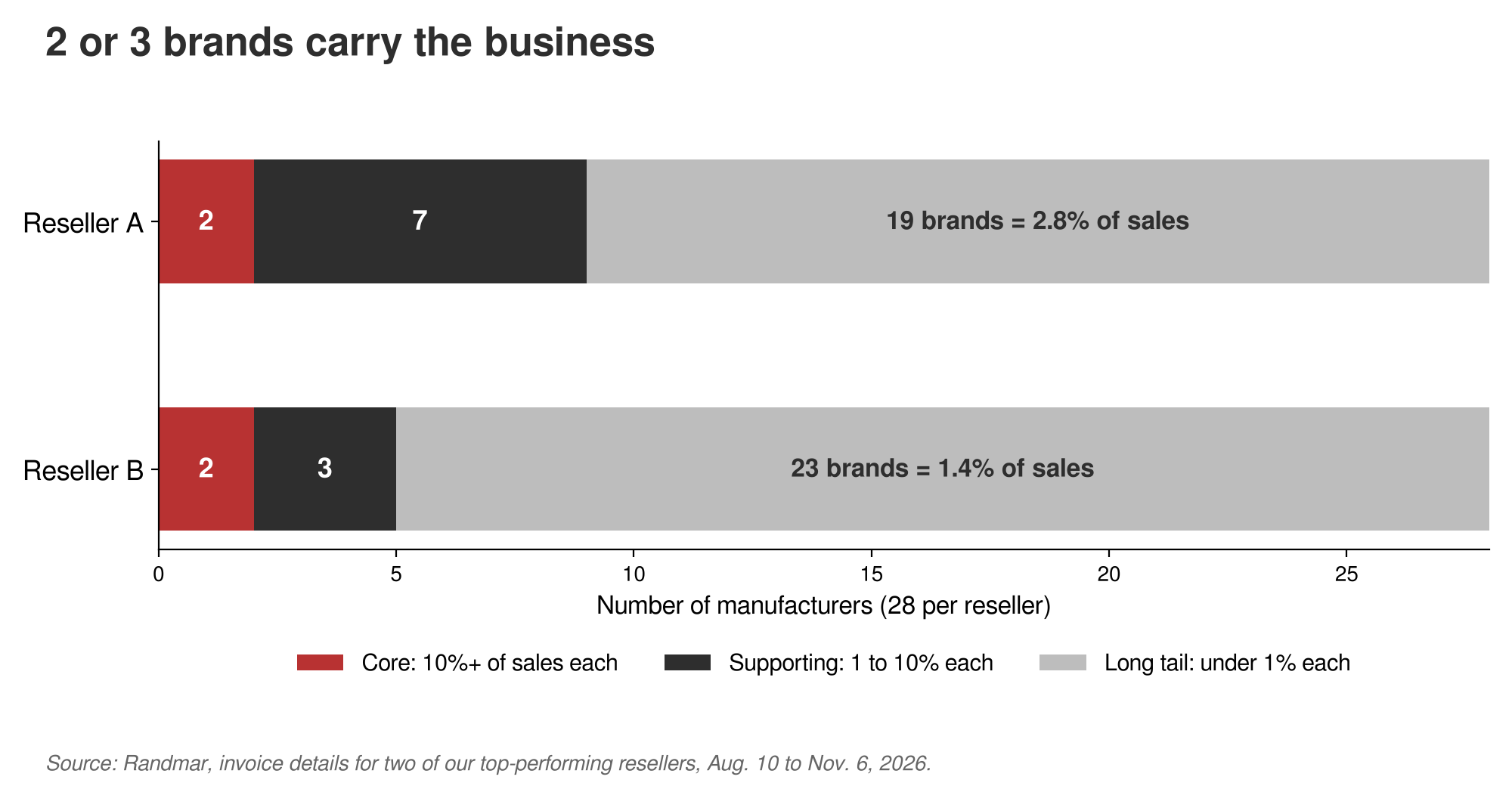
Source: Randmar, invoice details for two of our top-performing resellers, August 10 to November 6, 2026. Both resellers specialize mostly in printing supplies, which partly explains how concentrated their sales are; a more general store would likely be less extreme.
What it means for you: these are two of our best resellers, and even they make most of their money on a small, focused assortment. The long tail adds breadth, but very little revenue.
How to build an assortment that sells
Here's the advice I gave that reseller.
- Start with your market. Your established customers, or the market you're targeting.
- Define that customer base. Who they are, what they buy, what problem they need solved.
- Pick the products that fit that niche. Go deep on the core brands your customers already trust.
- Grow with your niche. As your customer base evolves and grows, add products to your assortment.
How Randmar helps you stay focused
- Curate, don't copy. With Randmar Connect, you can add product collections in a few clicks, so you sync the products that fit your niche, not the whole catalogue.
- Keep the long tail without the weight. All 20,000+ SKUs can be drop shipped from a single item, so you can add a product when a customer asks for it, without stocking it.
- Request what's missing. If a product your niche needs shows out of stock, you can request stock with one click, with no commitment.
My real point
Access to 20,000 products is a strength.
Trying to sell all 20,000 at once is a distraction. Start with your niche, and let it grow.
Your quick win this week
Pull your sales for the last 90 days and sort your products from best to worst. Find the point where you reach 80% of sales. Those products deserve your marketing budget. Question the rest.
Your turn
How many products are in your online store today, and how many of them sold last month?